
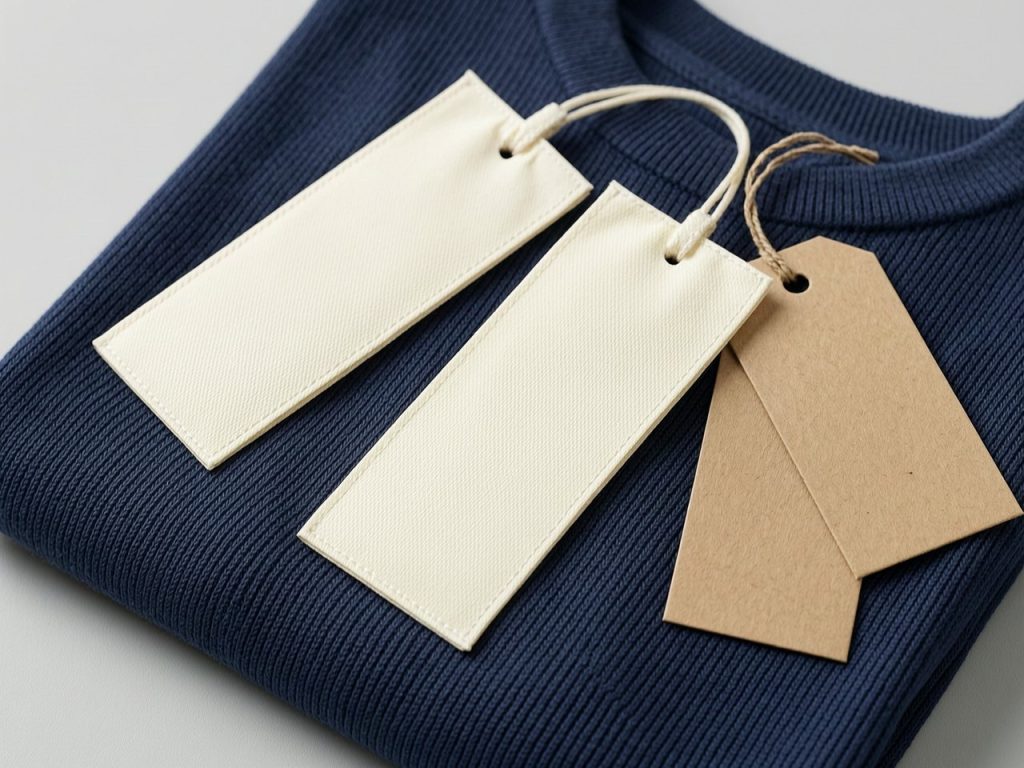
A label is a legal document sewn into a garment. When a shipment is stopped at the border or pulled from a shelf, it is rarely because the fabric was wrong; it is because the label did not state what the rule requires, or stated it in the wrong place, or printed it in a way that did not survive the first wash.
The responsibility sits with the company whose name appears on the label, which usually means the importer or brand, not the factory that sewed it in. That is worth understanding before the label artwork is approved, because fixing labels after production means either reworking garments or writing them off.
This guide covers what US and EU rules actually require, where the requirements differ, and what to put in the artwork file you send a supplier.
The label carries three separate jobs
It helps to separate what looks like one label into three overlapping obligations.
Identification — what the garment is made of, who is responsible for it, and where it was made. In the US this comes from the Textile Fiber Products Identification Act and its rules at 16 CFR Part 303. In the EU the fibre composition obligation comes from Regulation (EU) No 1007/2011.
Care — what the buyer has to do to keep the garment usable. In the US this is the Care Labeling Rule at 16 CFR Part 423. The EU does not harmonise care labelling the same way, which surprises buyers who assume the two markets mirror each other.
Commerce — size, colour code, carton marking and any retailer requirements layered on top. This is where a garment that is legally compliant still gets rejected at a warehouse.
What a US-bound label must carry
Three items are non-negotiable under 16 CFR Part 303: the fibre content, the country of origin, and the name or Registered Identification Number of the manufacturer or of the company marketing the product.
The fibre content has to be stated as percentages, using the recognised fibre names, and blended garments have to list each fibre present. “Performance polyester” is a marketing phrase, not a fibre name.
Country of origin has a placement rule that catches people out: a textile product with a neck must carry the origin disclosure on a label affixed to the inside centre of the neck. A hang tag is not a substitute for that requirement.
The care label is a separate rule. 16 CFR Part 423 requires care instructions that describe the regular care needed, attached so that they remain readable for the life of the product. There are exemptions — for instance where a garment can be cleaned safely under the harshest procedures, or where a permanent label would damage the item — but they have to be claimed deliberately, with the reasoning documented. Assuming an exemption is how brands end up with a compliance problem they did not know they had.
US rules also expect the label to be durable and conspicuous. A care label that turns illegible after a few washes is not compliant in practice, whatever it said when it was printed.
What changes for the EU
Regulation (EU) No 1007/2011 makes fibre composition labelling mandatory for textile products placed on the EU market. The fibre names used must be the ones listed in the regulation’s annex, and the composition is given in percentages, in the language or languages required by the member state where the product is sold.
What that regulation does not cover is equally important: care instructions, country of origin and manufacturer identification are not required by 1007/2011 itself. Care symbols are voluntary rather than mandated at EU level, and enforcement of care information varies between member states.
That does not mean care information is pointless in Europe. Recent EU product-safety rules put more weight on identifying the responsible economic operator and on giving information needed for safe use, and several member states have their own national requirements. The practical approach is to ask your buyer or compliance advisor which member states the stock will sell in, and to treat care symbols as expected by retailers even where the law leaves them optional.
A label file built only to US rules will usually pass in the EU on fibre content, but not the other way round: an EU label without care instructions fails the US requirement immediately.
Placement, permanence and print method
Placement is decided by the market and the garment, not by habit. The neck label is the conventional home for identity information, and for US-bound goods it is where the origin disclosure belongs. Care information can sit beside it, or in a side seam where it will not irritate the wearer.
The method matters as much as the wording. A woven label is durable but fixed at production, so every size, colourway or fibre change needs a new batch. A printed label is cheaper to change between runs but depends entirely on the ink and the heat setting; printed care text that fades after ten washes is a recurring cause of retailer chargebacks. Heat transfer labels sit between the two and are common on performance garments where a sewn label would rub.
Whatever the method, test it the way the customer will use it: wash the sample the way the care instructions say, then read the label. If the fibre content is unreadable after that cycle, the label has failed regardless of what the artwork said.
Size labels and the packing layer
Size identification is a commercial requirement rather than a fibre rule, and it is where factory output most often diverges from retail expectation.
Decide early whether the size goes on a separate label, on the neck label, or both, and whether the size system is US, EU or Asia — our product pages list US, EU and Asia sizing, and the same physical garment can carry three different size numbers depending on the market.
Then settle packing. Our product pages describe standard packing as four pieces per polybag with mixed colours in the same size, with custom packing available on request, and custom tags and labels offered as an option. Retail-bound orders usually need more than that: a size sticker or barcode on the polybag, a consistent folding method, and carton markings that match the purchase order. Every one of those is a written instruction, not something a factory should be left to infer.
The label file to send before production
Send one document that answers every question at once, rather than discussing labels across twenty messages.
It should contain the fibre composition with percentages for each colourway, the care instructions as both text and symbols, the country of origin, the legal name or RN to print, the size system and how sizes are labelled, the language versions required per market, the physical placement of each label with a measurement, the label construction (woven, printed or heat transfer), and the fold or finish if the label sits in a seam.
Ask for a physical strike-off or a sewn sample before bulk. Screen colours and woven thread colours do not match a PDF, and a label that reads grey where the artwork was navy is a reprint.
You can see the label and accessory side of our range on the woven label page, the garments themselves across custom sportswear and custom T-shirts, and the construction decisions that affect where a label can sit in our baseball jersey production guide.
FAQ
Does the factory or the brand own label compliance?
The brand or importer whose name appears on the label is responsible in law; the factory is responsible for making the label as instructed. That split is why the label file has to be explicit and approved in writing.
Can care instructions go on a hang tag instead of the garment?
Under the US Care Labeling Rule the instructions must be attached to the product so they survive use; limited exemptions allow alternatives, but they must be claimed rather than assumed. Treat a permanent label as the default.
Is a care label mandatory in the EU?
Regulation (EU) No 1007/2011 requires fibre composition, not care instructions. Care labelling is not harmonised at EU level, so requirements come from member states and from retailer policy — check the markets you actually sell into.
Do we need different labels for the US and the EU?
Usually yes. The EU label needs fibre composition in the required language; the US label needs fibre content, origin on the neck label, and care instructions. One label can sometimes serve both if it carries all three elements.
How do we stop printed care labels fading?
Specify the method, test a washed sample rather than an unwashed one, and write the durability expectation into the order. Printed labels on performance fabrics are the usual failure point.
Send your fibre breakdown, care instructions and target markets, and we will tell you what the label needs to carry for each one before artwork is released. Request a quote.